Start AI Adoption at the Bottom of the Company
By Armando J. Perez-Carreno / Featuring Kyle Brueckner
I talked with Kyle Brueckner of NewRocket about starting AI adoption with the people who do the work, and the judgment zone that appears once agents start asking for decisions.
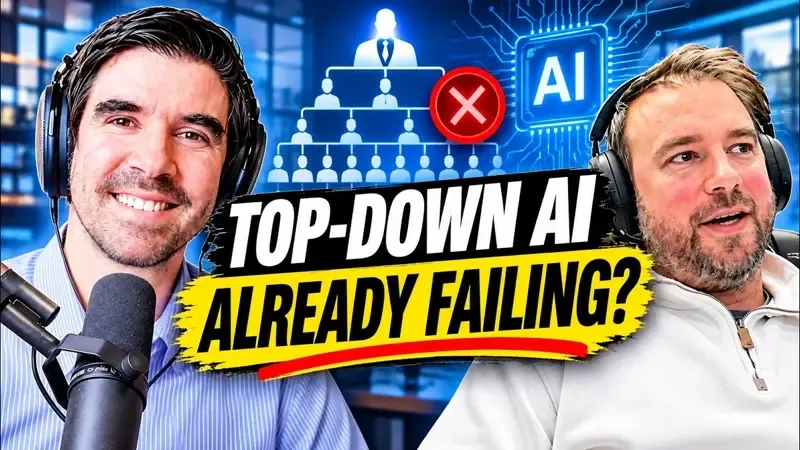
People who do the work every day should be the ones trying AI first, even if some of that work breaks or becomes shadow AI. Kyle Brueckner, VP of AI service delivery at NewRocket, says companies that drive AI strategy only from the top fall behind competitors who let their people experiment. Those experiments are where experience and new ideas actually show up.
In this episode of the Web Talk Show, I talked with Kyle Brueckner, VP of AI service delivery at NewRocket. NewRocket has long done ServiceNow implementations for companies, and it now works with Anthropic. The firm is building a team of forward deployed engineers to bring AI work to its customers.
Kyle is an engineer by trade. He left college early, spent a short stretch in construction, and became the go-to tech person in the office. That led to an IT job on ServiceNow, then into solution architecture and consulting. By 2019, he felt like he was on cruise control, doing the same kind of ServiceNow work again and again. Then AI showed up. He used it on side projects, saw how much better the work got with the right checks and balances, and later came to NewRocket to grow an AI practice.
ServiceNow started as an IT service management platform. Kyle said it grew because the foundation was a database and a workflow engine that can support almost any process. At large organizations it often becomes a hub that ties other tools and data together, and you'll see it a lot in regulated industries like healthcare, finance, and energy.
He walked through a change record in plain terms. Picture a finance company with servers that support a trade desk or a loan origination system. If you swap out memory, push new code, or raise the version of that loan app, you need a record of what changed. In ServiceNow, that record shows who requested the change, who approved it, and what was done. The work moves through request, review, approval, and implementation, then often a test, and then it gets closed. Each step stays linked, so you have a history you can follow if something later breaks.
Kyle also said ServiceNow was built with people in mind, and that change management designed for a human-led process is ready to be rethought for AI agents. Agents can go through git history much faster than a person can, which helps find a root cause when something fails. The step from a chat window to a team of agents working a whole codebase is what he calls the harness. It's a loop. The agent rechecks its context, plans the next steps, validates what it's about to do, acts on a computer or another system, and then checks the result against the original instruction. When many agents work together with clear interfaces and a defined job for each one, that loop can run at a much larger scale.
As those agents get more efficient, Kyle says you hit what he calls the judgment zone. The usual pitch is that you'll spend more time on strategy. On the way there, the agents start asking you to decide. Answering this or that can take two seconds. When those questions scale into the thousands, you become a reviewer. He says agents need a hierarchy and enough guardrails to decide some things on their own, so the person behind them can stay on the work that actually needs judgment and creativity.
I see that burden fall on a lot of people who want the agent to just do the work, until the decision layer gets blurry. Kyle's advice is to try things more than once, because each pass teaches you where a guardrail belongs. His 11-year-old daughter had an open shot in soccer and sent the ball 20 feet over the goal, and that feeling is now part of what she knows for next time. His line stuck with me: those grains of sand become mountains.
Kyle described a forward deployed engineer as a Swiss army knife: someone who can talk with a customer, understand the business, and build a solution quickly. At NewRocket, a support system sits around that person. He called it a deep bullpen, and he thinks people pick things up just by being in the room, the way he learned configuration management databases by sitting next to the person who owned one at his first job.
When I brought up the fear of shadow IT, and the argument that AI has to be rolled out from the top, Kyle said driving AI strategy only from the top is failing, and that it should start at the bottom. Even if some things break, that's where innovation happens and where people gain the experience leaders should want. Forcing one tool and one way of working can leave a company six months, a year, or two years behind an AI-native competitor that found a better way in a week or two.
At the end of the day, Kyle would start with culture and collaboration, not a governance board that writes rules and a person whose job is to check them. That setup will slow you down. He wants teams to build the guardrails together and make them something people can use, like a clear path for a new application, instead of sitting down to describe rules for technology you barely understand. If you want to learn more, Kyle said to start at newrocket.com, and you can also find him on LinkedIn.
Watch the full episode on YouTube, or listen on Spotify.