AI Voice Agents Sound Great Until a Real Customer Calls
By Armando J. Perez-Carreno / Featuring Karan Kanwar
I talked with Karan Kanwar of Wing Assistant and Central AI about what it takes to run a voice agent at a medical front desk, where callers are frustrated and not in a quiet room.
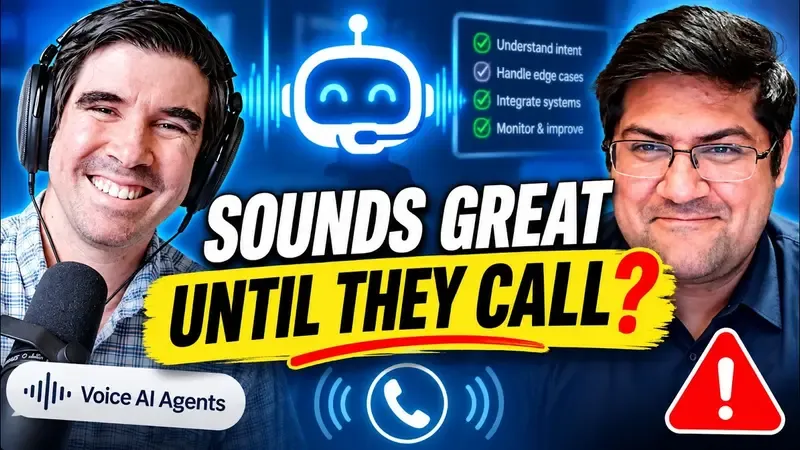
Anyone can connect a language model to a voice and some data and have a working voice agent in an afternoon. Karan Kanwar, CEO of Wing Assistant and Central AI, says the hard part is keeping it fast and reliable when thousands of calls come in at once, and when the person on the line is frustrated and not in a quiet room.
In this episode of the Web Talk Show, I talked with Karan about what it takes to run a voice agent at a medical front desk, and what most demos leave out. I build voice agents too. I have a LiveKit receptionist people can call at (210) 987-4321. It uses Deepgram for speech-to-text, Grok as the language model, and xAI for speech. That's my own proof of concept. Karan's work is about running this kind of system when a real patient is on the line.
Wing Assistant helps businesses hire talent, including executive assistants, receptionists, and developers, for clients from small shops to Fortune 100 companies and governments, across more than 300 kinds of work. From that work, Karan's team saw a repeated need at the front desk. Central grew out of that. It builds voice, chat, and fax agents for the front desk, and it started in healthcare because that's where they saw the most pain and the most room to help.
The easy demo is only the start. In healthcare, you have to be careful not to share too much information. Getting one call to feel snappy is one thing. Keeping that speed consistent across thousands of calls at the same time is a large engineering problem. Many companies say you'll never miss a call, and living up to that means planning for outages in the phone network and in the other services you depend on. Owners also need a way to see why the agent did what it did. They try a tool, then ask why it made up a price. Karan's team uses other agents to check the faster ones, so the system is less likely to invent medical or legal advice.
Booking a time is not enough. That appointment has to land on the right schedule, a message may need to go out, and the right doctor has to be chosen. Karan described practices with 15 providers, where some are not a fit for certain conditions, some work limited hours, and some work more like contractors and choose whether to take a patient. In his view, a lot of competing tools add a voice layer on top of an existing product and don't account for that mess. Some customers have already tried something else and found it wasn't customizable enough. Others are new to voice agents.
He treats onboarding like training an employee. You collect context and teach the agent what to say and how to use the systems. In their case, the first onboarding can take about an hour. After a week, you look at the mistakes, explain what you didn't like and why, and the agent can improve from that correction without hearing it many times. Central also built a simulation suite that can run thousands of callers, including angry or challenging ones, before a clinic relies on the agent. A perfect test call, with a clear voice and a quiet room, is not the average call. Karan's picture of the average call is someone who is frustrated, maybe swearing, and sounds like they're talking through a potato. I told him about a demo on a conference floor, with hundreds of people talking around the booth. The agent had to pick out the person at the phone, not the room. That's voice activity detection: deciding when the caller is speaking, when the background is noise, and when to answer without cutting the person off.
Karan walked through the two pipelines most teams use today. One is a newer voice-to-voice model, like the live voice mode in ChatGPT, that can listen and respond at the same time and then gets routed over the phone. The other is the more traditional path: speech-to-text with a service such as Deepgram or Whisper, then a language model, then text-to-speech with a provider such as ElevenLabs or Cartesia. Each hop adds delay. In this space, he said a reply should come back in about 400 milliseconds. Around 800 milliseconds can still be fine. Early on, Central ran on an East Coast server, and the delay was too much for clients on the West Coast. They had to run the service in more places and make the same pipeline hold up when a thousand calls arrive at once.
Once you can see what's in a call, you also have to protect it. Karan described a practice that has to follow HIPAA and serves children, where patient data can't reach the quality-check pipeline, and often can't appear in the transcript or the recording either. If someone is sitting next to five other people while looking at a transcript, they may not be allowed to see that information at all. The same care shows up outside healthcare. He mentioned a karate studio they worked with, because that business also holds information about children.
Niching down is what made a request like "fax it to me" easy. Last week, a customer asked them to run insurance verification at the end of a call and fax the details over. The client likes paper. Central already had fax in its healthcare workflows, along with hundreds of other modules, so they could string that together instead of building it for one person. I had talked about this earlier in the week with Sean Lang: when you stay in one industry, the next unusual request is often something you already built. Karan said niching down used to feel like a weakness, because Wing Assistant works across so many industries. In healthcare, the need was clear. Clinics already spend a lot on the front desk, still miss calls, and still struggle after hours.
Computer use is how an agent can work inside an old system that has no integration. The agent can click around in a browser, or even in desktop software from the 1990s on an old Linux machine. A doctor Karan spoke with was using a record system that was terrible at integrating with anything, and his first reaction was that this sounded too good to be true. The catch, for now, is speed. Computer use is still a bit slow, even when the demos look great. In healthcare, Karan also limits how freely an agent can click around, so it doesn't open patient charts it doesn't need. For most of those customers, they offer a more limited agent that you train on exact steps, sometimes by recording your screen, instead of giving it a goal and letting it poke around.
Quality checks still matter once calls are running. Central recently added agents that review other agents. Karan said you can review thousands of interactions for about $30, and you can often tell whether a miss came from a line of code an engineer wrote or from a prompt the customer or the onboarding team wrote. We also talked about decision models like Jev, which can answer a yes-or-no question across a lot of data quickly and at a low cost. At Wing, they use Jev on hundreds of sales and customer success calls every day. For the voice agents, they still lean on a more traditional model, closer to Opus, because that set of calls is more controlled.
If you're thinking about building or buying a voice agent, Karan's advice has two parts. First, get clear on who you want to serve and what problem you want to solve, because that decides how deep you have to go on privacy and compliance. Second, look at the whole pipeline before you start, including the connections to other systems, who can access what, and a way to see whether the agent is doing a good job, so you aren't adding those pieces later.
You can find Central at trycentral.com, and Wing Assistant at wingassistant.com. Both teams are glad to hop on a half-hour call.
Watch the full episode on YouTube, or listen on Spotify.