Why Niching Down Helps an Agency Grow Faster
By Armando J. Perez-Carreno / Featuring Sean Lang
I talked with Sean Lang of Agency Uplift about why a focused offer is easier to sell, deliver, and price, and why saying no can help an agency grow faster.
Digital agencies are easy to start and hard to run. Sean Lang spent eight years learning that the hard way. He and a friend took almost any local small business that would pay, often on a handshake, with no real scope or contract. They paid what he calls a lot of idiot tax, scaled to a million, got stuck there for a number of years, shrank, and later grew again. This July the agency had about 75 people, and they sold it. He now coaches agency founders one-on-one and in groups through Agency Uplift. He's frank about the stress. Six months in, everything can be on fire, no one is sleeping, and the work feels like endless whack-a-mole.
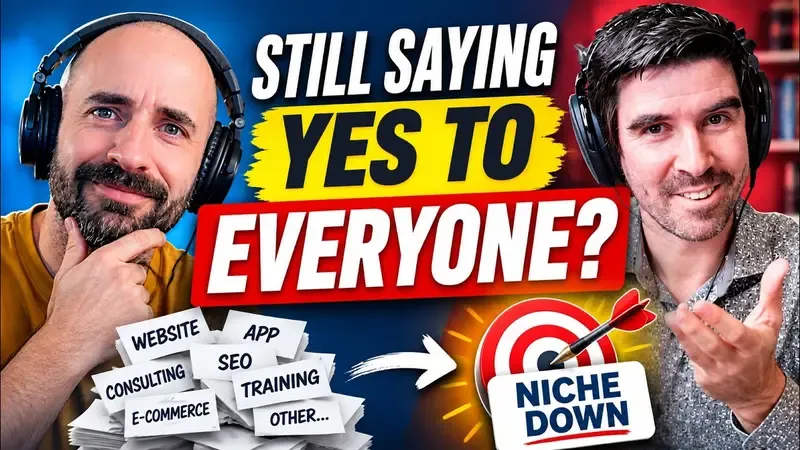
In this episode of the Web Talk Show, I talked with Sean about why niching down feels risky, and why a focused offer is easier to sell, deliver, and price.
Sean usually means digital performance agencies when he talks about this work: teams hired to produce a result, like more leads for a small business or more profitable sales for a brand. If you're about to hire one, his advice is simple. Ask for a track record with clients like you, and walk through the process so you can see how the work actually gets done. A full-service shop that claims to be great at everything, for everyone, is rare. The shops that get really good usually solve a specific problem, with a specific service, for a specific kind of client. They can charge more and work with fewer people, and the results can still come out ahead.
I brought up the usual pushback: if you niche down, you miss out on people who would have paid you. Sean agreed that you will. The trade-off is the point. Saying yes to every small job is also saying no to the bigger swings that can move you several rungs up the ladder. In the moment it feels like leaving money on the ground. In his early years, the agency was stuck in that scarcity mindset. He wishes he had pushed back harder. Every new client meant reinventing the wheel, whether the work was custom homes, chiropractors, or plumbers. If they had stayed in one box, each new client would have made the next one better.
He's a drummer, and he used that to make the point. He's spent decades getting good at drums. Taking a paid gig on guitar, then standup bass the next week, would just mean a string of bad shows. Musicians specialize. Agencies often don't, even though the work is the same idea: create a clear outcome for someone else.
Sean now works only with agency founders, even though he sees how the same ideas could apply to other businesses. Trying to help everyone at once is what makes the work hard. He used to work with direct-to-consumer brands, and he says you can change your focus when you need to.
He also draws a line between scaling sales and scaling a business. A lot of gurus teach people how to sign clients and call that growth. Holding on to the revenue, then adding more, is the actual work of scaling. Agencies that only pour new clients into a leaky bucket are what he calls churn farms.
The leak is often the client experience. Results won't matter if the client leaves first. He wants agencies to decide how the client should feel at each step, then build the habits that make that likely. Sending a report and waiting for a call isn't enough. He'd rather walk through the numbers and tell the story so the client knows what to do with them.
Structure is how he keeps that from slipping when the next fire shows up. He designed the onboarding, then a client communication policy. A daily 3-to-5-minute Loom video was too much, and clients didn't watch. The agency settled on a weekly meeting, a Monday morning check-in, and a Friday wrap-up. Clients knew what was going on, even when the news wasn't good. The tone shifted from "what are you doing about it" to a sense that the team had it under control. Clients hired the agency because they believed it knew something they didn't. If you stop proving that, they'll look elsewhere. Focus helps here too. If you've seen the same problem many times, you can explain what's going on and what you'll try next.
We also talked about the claim that a fully agentic agency can replace the team. Sean thinks most of those stories are oversold. A relationship still needs a person. If Claude misses the Meta results, canceling a subscription is about all you can do. He met a founder who had grown quickly with a small team and a large group of agents. The day that founder was supposed to be on Sean's podcast, the whole agentic system went down, and the agency was stuck because no one on the team owned the outcome. Sean wants people first, with AI used to give each role more leverage by taking the low-leverage work off their plate.
If you want to scale without living from fire to fire, Sean starts with a clear picture of what you're building, what your role should look like, and where you add the most value. Then he comes back to three principles: clarity, visibility, and follow-through. Pick the one offer that creates the value, go deep on it, and you may not need as large a team.
You can find him at agencyuplift.co, and he also has a podcast, with two new episodes each week.
Watch the full episode on YouTube, or listen on Spotify.